Monday, 19 May 2014

How to get best features of Windows 7 on Windows 8

Microsoft made some useful improvements to Windows Explorer in Windows 8, but they also (inexplicably) took some things away. OldNewExplorer gives you the best of both worlds: use the Windows 8 features you like, and bring back the Windows 7 features you miss. 

OldNewExplorer is easy to install: just extract the necessary files to a folder on your system, open up the portable preferences app, and click the Install button. This will install the necessary system files to tweak Windows Explorer. From there, you can check and uncheck the features you want, so you have the perfect Explorer for you. 

With OldNewExplorer, you can ditch the ribbon, bring back the details pane at the bottom of the window, and more: 

If you want to uninstall the tweak, just open up the configuration window and click the Uninstall button. Hit the link to read more and try it out.

Sunday, 11 May 2014

How to locate a lost smartphone

If you've ever lost a smartphone, you're well aware the cost to replace the hardware is the least of your worries. What resides on the phone — including private personal or corporate information — isn't something you want falling into the wrong hands.

Locking a smartphone with a password or PIN isn't enough. To really secure your device, you should take advantage of free services that let you remotely wipe the data from a lost or stolen phone.

You can also locate your device on a map to retrieve it — though if it's stolen, you should give the information to the authorities rather than trying to handle it yourself.

There is a catch, however: You need to set up these free services before you lose it.

So long as you're proactive about it, and spend the five minutes to sign up before it's too late, the following is what you need to protect your smartphone — whether it's an iPhone, Android, Windows Phone or BlackBerry.

iPHONE

There are two official ways to locate your misplaced iPhone: sign into iCloud.com on a computer and select Find My Phone or launch Apple's Find My iPhone app on another iOS device (iPhone, iPad, iPod touch) or on a Mac. Find My iPhone is available for free at the App Store.

For both, you can see where your device is on a map, along with the date and time it was last located there, along with the phone's current battery level (top right corner).

If it isn't locked with a PIN, you can do this remotely. And why not send a message that will appear on the screen, such as your contact info or a small reward offer, if a Good Samaritan finds it?

Alternatively, you can have it ring loudly, even if the device was on mute — in case, say, you left it between couch cushions.

Or wipe the data clean if you don't want to take a chance of it being accessed.

ANDROID

There are many third-party apps to track, lock and wipe a missing Android phone.

But Google's own Android Device Manager, launched last fall, is available as a free download from the Google Play store. Or you can log into android.com/devicemanager on a PC or Mac.

For either method, you'll first be prompted to sign into your Google account.

You might have your phone ring loudly in case it's somewhere nearby (even if it's on silent/vibrate). If it's not nearby — perhaps left at a friend's house, in the car or at a restaurant — you can locate your Android phone on a map in real-time.

Remotely add a screen lock to your device, if it didn't already have a password, PIN or pattern lock on it.

Failing all this, if your phone can't be recovered, or has been stolen, you can easily wipe all of the data on your device.

This service is available on devices running Android 2.2 or above.

WINDOWS PHONE

If you own a Windows Phone, such as a Nokia Lumia device, and you've misplaced it, Microsoft's Find My Phone is a free service that might be able to help.

Go to windowsphone.com on any Internet-connected computer or mobile device and sign into your Windows Live ID associated with your phone.

Like the other apps highlighted in this article, Find My Phone makes it easier to recover your phone or to prevent someone from using it without your consent.

You can ring, lock, erase or show your phone on a map.

After logging into windowsphone.com with your password, click Find My Phone and follow the instructions. Microsoft suggests making a hard copy of your phone's location if your computer is connected to a printer.

Alternatively, click Ring to hear your phone if it's in earshot. Click Lock to lock your missing or stolen device (only if you haven't set up a lock screen previously) and perhaps type a message to display on your phone's screen (usually an alternative phone number or an e-mail address, so you can be contacted). To wipe your phone clean, click Erase and then select I'm Sure from the confirmation screen.

BLACKBERRY

Finally, BlackBerry owners can download the official BlackBerry Protect app from App World, and sign up for the free service.

If your BlackBerry is missing in action, you can log in to a website (blackberry.com/protect) to see the smartphone on a map and remotely scrub its data, so no one can access it.

Or you can set a password and lock it remotely, make your BlackBerry ring loudly or display a message on the homescreen instructing whoever finds it on how to return it.

As a proactive measure, BlackBerry Protect — as its name suggests — also lets you wirelessly back up your contacts, text messages, calendar, memos, tasks and bookmarks; this is all done automatically after you choose how often you'd like to back up your data: daily, weekly or monthly. Then you can wirelessly restore your backed up data when switching to a new BlackBerry.

Skim milk can actually be really bad for your heart.

If you're one of the health conscious, then you’ll have encountered a lot of conflicting information on what is and is not healthy for you. Take skim milk, for instance, a beverage hailed as healthy for all given it allows one to gain all the vitamins found in milk. However, just like with everything else, more researchers are coming to the realization that skim milk is no better than your regular fatty milk.

The reason behind the explanation is simple: as fat is removed from milk, a lot of crucial vitamins are also eliminated, which in turn are replaced with synthetics. Moreover, most of the manufacturers use a powdered form of milk to fortify their skim milk, and what this does is oxidize the cholesterol in the milk.

Oxidized cholesterol leads to the accumulation of plaque in the arteries, and consequently, atherosclerosis (a stage of coronary heart disease). Thus, when you drink skim milk that you think helps you in avoiding heart disease, what you’re doing is actually consuming oxidized cholesterol which sets the process of heart disease into motion.

Wednesday, 23 April 2014

Facebook powers 51% of social logins in North America

WASHINGTON: Facebook reportedly powers more than half of all social logins, according to latest data.

The data by social login service Gigya revealed that Facebook now powers more than 51% of all social logins in North America, thereby retaining its market position, TechCrunch reports.

Meanwhile, Google+ acquired the second place with 31% of social logins in North America.

Yahoo grabbed the third place with just 15%.

Twitter turned out to be a minor player in the social login world as it recorded only 4% in both desktop and on mobile through Gigya's services, the report added.

What smartphone to buy, Samsung Wave or Samsung Ace?


The Samsung Wave II fulfills all your requirements in that price segment. However, the phone currently runs on Bada v1.2 and although Bada 2.0 demos were shown on the Wave II, there is no official confirmation from Samsung that the Wave II will be updated to Bada 2.0 in the future. 

Instead of the Samsung Ace, we would recommend that you go for the Motorola Defy in that price segment. It features a 3.7-inch touch screen display in a rugged form factor and is powered by a 800Mhz processor. 

It runs Android operating system with a great music player and superb social network integration. The phone sports a 5MP camera with image stabilization and records videos in VGA resolution.

Google working on end-to-end encryption in Gmail

NEW DELHI: In the wake of the NSA surveillance revelations, it looks like Google is gearing up to make Gmail more secure and is working on integrating encryption tools like PGP or Pretty Good Privacy, easier for end-users.

According to a report by Venture Beat, Google is carrying out research to make PGP easier to use with Gmail. PGP is an open source encryption standard that allows users to send encrypted data that can be decrypted only by the user who holds the encryption keys.

The report cites a person familiar with the matter as the source of the information. PGP is compatible with Gmail but it is not easy to use and third party encryption services like Mailvelope have failed to go mainstream. The report cites the source as saying that 'end-to-end encryption is the best defense for message protection, though it comes at considerable cost in functionality.'

It is not clear how Google plans to integrate the encryption mechanism in Gmail, at this point in time. It would be difficult for Google to widely implement it as PGP does not support password resets and users will lose access if they forget their passwords. If Google stores the keys on its servers, these will also be susceptible to surveillance. If it gives them to users, there'll be no way to reset them if the user loses the keys.

Also, Google's business model requires Gmail to serve targeted ads by reading the users' messages. The ad serving engine won't be able to read encrypted messages.

Tuesday, 22 April 2014

Microsoft, HP partner to launch tablets for college students in India

NEW DELHI: IT major Microsoft has partnered with HP and Pearson to launch a tablet for higher educational students in engineering and management streams. 

The companies will jointly launch the Windows 8.1 powered 10.1 inch Hewlett-Packard (HP) Omni10 tablet with embedded content from Pearson and Microsoft Office in the higher education space. 

Priced at Rs 29,999, this is the software giant's second offering. In February this year, it had unveiled the Acer Iconia W4-820, priced at Rs 24,999, with Acer, MBD Group and Tata Teleservices for private schools (K6-12 level). 

"These customised tablets will make learning interactive and immersive and is part of our continuous efforts to make education more inclusive through technology. We believe that these are game changing devices," Microsoft India Head (Public Sector and Education) Arun Rajamani told PTI. 

The Omni10 tablet packs in the best of HP, Pearson and Microsoft's offerings and has been specifically designed to provide students with an engaging learning experience, he added. 

On market potential, Rajamani said the addressable market for HP Omni10 would be the five million students undergoing technical and management studies. 

The Acer Iconia W4-820, on the other hand, had a bigger addressable market of around 30 million since it targetted the school students, he added. 

The HP Omni10 will be available for all technical and management institutes and is being currently offered at an EMI plan of Rs 2,990 per month for 12 months (taxes additional). 

"This special limited time 'Institute Offer' is valid till June 15," Rajamani said. 

Microsoft will provide a preloaded set of 10 e-books, access to various Microsoft developer tools and servers through the DreamSpark student site, single sign-on student mail IDs as well as a 50GB mail box and 25GB OneDrivePro free. 

The tablet runs on Intel Atom processor Z3000 series, HP India director (computing category, printing and personal systems) Ketal Patel said. 

"Engineered to assist students with their hectic work schedules, this tablet provides powerful performance for multitasking, making presentations, playing games and music. A carry cover for the HP Omni10 tablet will also be provided in the offer," he added. 

The tablet is protected by Corning Gorilla Glass 3 and has up to 8.5 hours of battery life, 2GB RAM, 32GB internal memory, which can be expanded to another 32GB using a microSD card. 

It has a 8megapixel rear and 2MP front camera.

Micromax Canvas Doodle 3 launched at Rs 8,500

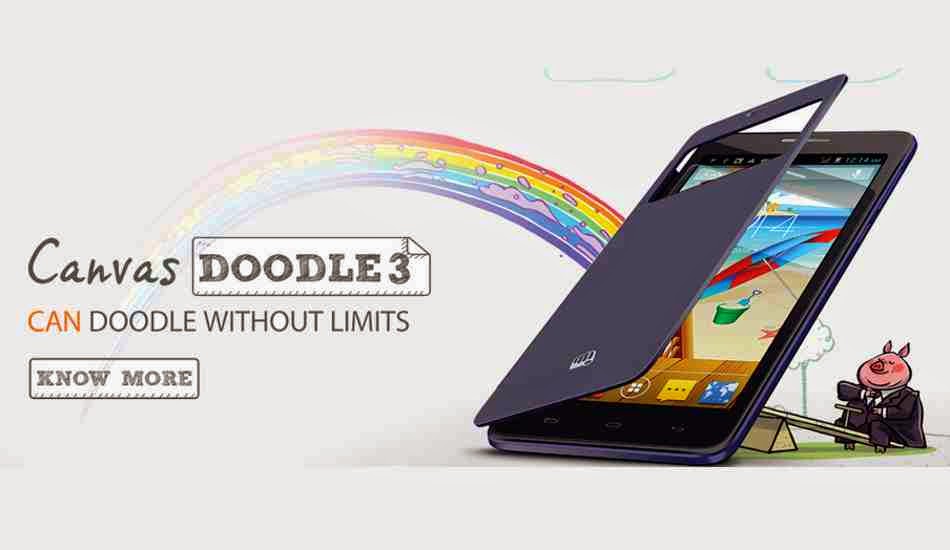
NEW DELHI: Micromax has launched the third iteration of its Canvas Doodle phablet at a price of Rs 8,500. It will be available starting April 25.

The Canvas Doodle 3 sports a 6-inch FWVGA (480 x 854p) display, making it the biggest Micromax phone. It is powered by a 1.3GHz dual-core MediaTek MT6572 processor and 512MB RAM. The phone comes with 4GB internal storage, with support for microSD cards of up to 32GB. It runs Android 4.2.2 Jelly Bean.

Canvas Doodle 3 sports a 5MP rear camera with LED flash and a VGA front-facing camera. In terms of connectivity options, the dual-sim (GSM+GSM) phone offers 3G, Wi-Fi, Bluetooth 3.0 and GPS. It comes with a 2,500mAh battery.

Micromax is also bundling a magnetic flip cover with the Canvas Doodle 3. The phone is one of the cheapest large screen phones available in the Indian market. However, in terms of hardware specifications, it is a downgrade compared to its predecessors.

TCS joins top 10 global IT services companies club

BANGALORE: This is a landmark for Indian IT. The country's largest IT services provider, Tata Consultancy Services (TCS), has broken into the league of top 10 global IT services companies, moving from the 13th position in 2012 to the 10th spot in 2013.

Twelve years ago, when TCS' revenues were about $1 billion, then CEO S Ramadorai had laid out a vision to be among the top 10 by 2010. It's taken a little longer, partly because of the global financial slump of 2008-09, but the company has now got there, and considering the pace at which it is growing compared to its global counterparts, the ranking could get better fairly quickly in the years to come.

"Talk to any incumbent western service provider today, and the one making them all tremble from the sub-continent is TCS," writes Jamie Snowdon, executive VP of research operations at HfS Research, the consultancy firm that compiled the ranking.

TCS is estimated to have IT services revenues of $10.1 billion (out of its total revenues of about $12.5 billion). IBM ($54.4 billion), Fujitsu ($32.1 billion), Hewlett-Packard ($29.2 billion) and Accenture ($25.4 billion) lead the list.

The research compares IT services, and excludes other areas such as BPO, R&D services and software/hardware products. And it uses figures for the four quarters of calendar year 2013. TCS rose to the 10th spot displacing Montreal-based IT services firm CGI.

India-based companies Cognizant, Infosys, Wipro and HCL are at the 15th, 18th, 20th and 25th positions, respectively, all of them rising by one to three spots compared to 2012. HfS Research believes that Cognizant could be in the top 10 in the next 2-3 years, may be at the expense of US IT company CSC. CSC's revenues last year had dropped compared to the year before.

On TCS, HfS says its aggressive targeting of renewals and new business, particularly in continental Europe, was an important factor in driving its assault on the leaders. TCS, it said, is frequently seen as being the most flexible service provider on pricing and terms, and has a developing reputation for winning any deal anywhere in the world at any price, if it really wants.


"The firm is increasingly being perceived by many today as an alternative provider to the Western Tier 1s, that can come in and fix messy contracts and implementations; it has shown an appetite and willingness pick up a lot of the low-margin, low-value work that seemingly every Western Tier 1 wants out of and make the deals profitable and leverageable across clients," said Phil Fersht, CEO of HfS. TCS also has an extraordinary profit margin, something that's normally difficult to achieve in conjunction with high revenue growth.

Micromax starts manufacturing smartphones in India

NEW DELHI: The country's second largest mobile devices company Micromax has now started manufacturing handsets at its Rudraprayag facility in Uttarakhand. 

"Micromax has manufacturing plant in Rudraprayag where it manufactures LED and tablets. The company started manufacturing mobile phones couple of months back," a Micromax spokesperson told PTI. 

The spokesperson added Micromax is producing all the tablets that are being sold in India at this facility but mobile phone production is at initial stage. 

As per the industry data, Micromax is the second largest players in both mobile phone and tablet PC market in India. 

The company had 13 per cent market share in total mobile phone segment and 16% in smartphone market in last quarter of 2013 as per market research firm IDC. 

Micromax had 8.9% market share in Indian tablet PC segment which stood at 4.14 million units in calendar year 2013. 

The company targets to almost double its revenue to $1 billion (over Rs 6,000 crore) by end of financial year 2013-14 from revenue of Rs 3,168 crore in FY 12-13. 

Micromax did not comment on latest revenue figure.

Apple to recycle all products for free

SAN FRANCISCO: Apple is offering free recycling of all its used products and vowing to power all of its stores, offices and data centres with renewable energy to reduce the pollution caused by its devices and online services.

The iPhone and iPad maker is detailing its efforts to cultivate a greener Apple in an environmental section on the company's website that debuted Monday. The site highlights the ways that the Cupertino, California, company is increasing its reliance on alternative power sources and sending less electronic junk to landfills.

Apple had already been distributing gift cards at some of its 420 worldwide stores in exchange for iPhones and iPods still in good enough condition to be resold. Now, all of the company's stores will recycle any Apple product at no charge. Gift cards won't be handed out for recycled products deemed to have little or no resale value.

The offer covers a wide array of electronics that aren't supposed to be dumped in landfills because of the toxins in them. In the past seven years alone, Apple has sold more than 1 billion iPhones, iPods, iPads and Mac computers.

The new initiative, timed to coincide with Tuesday's annual celebration of Earth Day, strives to position Apple as an environmental steward amid the technological whirlwind of gadgets and Internet services that have been drawing more electricity from power plants that primarily run on natural gas and coal.

Technology products and services accounted for about 2 percent of worldwide emissions in 2012, roughly the same as the airline industry, according to statistics cited by environmental protection group Greenpeace in a report released earlier this month. Some of biggest electricity demands come from huge data centres that house the stacks of computers that process search requests, store photos and email and stream video.

These online services, often dubbed "cloud computing," collectively consume more electricity than all but five countries - China, the US, Japan, India and Russia.

As the world's largest technology company, Apple is trying to hatch more environmental solutions than problems.

"What the company wants to do is use all our innovation and all of our expertise to make the planet more secure and make the environment better," Lisa Jackson, Apple's vice president of environmental initiatives, said in a Monday interview. Jackson ran the Environmental Protection Agency under President Obama before joining Apple last June.

Apple CEO Tim Cook underscored the commitment by narrating a 1 minute, 44 second video about the company's efforts to protect the environment. "To us, better is a force of nature," Cook says in the video.

The campaign appears to be more than just public relations stunt, based on Greenpeace's high praise for Apple in its recent review of the technology industry's environmental responsibility.

Among the 19 companies covered in the report, Greenpeace described Apple as "the most innovative and most aggressive in pursuing its commitment to be 100% renewably powered." Greenpeace also gave high marks to Apple rival, Google, and Facebook, which makes one of the most popular apps on the iPhone and iPad.

All four of Apple's data centres, which are located in North Carolina, Oregon, Nevada and California, already rely entirely on renewable energy, the company said. The electricity comes from a variety of alternative sources, including biogas, as well as wind, solar and hydro power.

That means whenever people are interacting with Apple's iTunes store, sending messages or engaging in video chats, they "can feel comfortable that they are not adding any carbon pollution to the atmosphere," Jackson said.

About 94% of the power in Apple's offices in the world is now supplied by renewable energy sources, up from 35% in 2010, according to the company. Apple is building a new 2.8-million-square-foot headquarters in Cupertino that will be powered solely by renewable energy when it's completed in 2016.

About 120 of Apple's US stores, or nearly half of the outlets in the country, run entirely on renewable energy. The stores running on renewable energy include locations in New York, Chicago, San Francisco and Santa Monica, California. The company isn't specifying a timetable for meeting its goal to convert its other 300 stores in the world to renewable energy.

Monday, 21 April 2014

Is there any free or paid software which can be used to create high-quality images?

Probably the best free image editing and drawing application you can use is GIMP (www.gimp.org). And if you want to go to the paid route, go with Adobe Photoshop — the current version is Photoshop CS5. 

With both these software packages, it's easy to get started because you'll find hundreds of tutorials (even video tutorials) online for free. Note that if you have a tablet like the Samsung Galaxy Tab or Apple iPad, you can also download various drawing/doodling applications from their respective app stores, both free and paid. 

Finally, you might want to consider purchasing a Wacom drawing tablet — you can use this in tandem with your software package of choice, and it'll give you enhanced precision as compared to just using a mouse.

How to clean up Windows

Piriform makes several free tools to keep your Windows PC in shape, most popular of which is Cleaner. The latest release of Ccleaner (v3.05) now supports Firefox 4 and Internet Explorer 9 — it clears out all the temporary files, history, cookies and form history from web browsers. 

Apart from Firefox 4 and IE9, Ccleaner supports almost all the popular browsers like Opera, Safari, Chrome, Phoenix, K-Meleon and SeaMonkey. 

It can also clean up your Windows registry, recycle bin, temporary Windows files and remove traces of previously installed programs. You can download various versions of Ccleaner (normal, lite or portable) from www. piriform.com .

How can I watch TV on mobile phone?


Probably the easiest way to do this is to get a TV app for your phone. Some of the more popular ones are Mundu TV (www.mundu.tv) and MimobiTV (www.mimobi.tv). 

Both these apps are paid, and are compatible with a variety of devices across different platforms (including iPhone, BlackBerry, Android, Symbian, Windows Mobile and Java-based handsets). 

In case of Mundu TV, an 8-channel package is available for 79 monthly or for 129 quarterly (data charges extra). There are only nine channels to choose from and you can see the options on the website. 

In case of MimobiTV, there are more channels to choose from and they have tied up with various service providers. For example, in case of Airtel, it costs 40 per week to watch all channels while in case of Vodafone, it costs 30 per channel per month. Details of the various available channels, prices according to different operators and the procedure to download for each operator is given on their website.

How to block specific websites

If certain websites take up too much of your day, you can simply block them using browser extensions. With Firefox, you can get the LeechBlock extension from https: // addons.mozilla.org. With Leech-Block , you can specify upto six 'sets' of websites to block, with different times and days on which to block each set. 

There's a lockdown feature, using which you can immediately block a website for a specified duration. Finally, it can also keep track of the amount of time you spent browsing the sites in each set. 

If you're using Google Chrome, you can get 'Website Blocker' or 'Chome Nanny' from https: //chrome. google.com/ extensions. They work similarly, although they do not have as many features as LeechBlock.

Is it better to purchase Sony PlayStation 3 from US rather than India?

While it's true that the prices are lower in the US, in this case you can chalk it up to the import duties and customs levied by our country. 

There are a few disadvantages to buying the Sony PS3 from the US. 

To start with is the most obvious: lack of warranty. If your system fails for any reason, Sony India will not be able to help. In fact, in many cases, Sony will just replace a faulty system rather than repair it-provided the system is under warranty. 

Second: Input voltage 
Unlike laptops and cellphones which now have universal power adapters, a Sony PS3 purchased from the US will likely have an input voltage of 110V (as opposed to 220V that is used in India). 

To use such a system in India, you will need a 220V to 110V step-down transformer. While these are easily available, if someone accidentally plugs the system directly into a 220V outlet, the damage might be irreparable. 

Third: Blu-Ray region locks 
The Sony PS3 is a very capable Blu-Ray disc player, but Blu-Ray players are still region locked-meaning they will only play discs encoded with a specific region format. 

There are three Blu-Ray regions; Region A for the Americas and certain parts of East and South-East Asia, Region B for Africa, Middle East and Europe and Region C for Central Asia, China and India. 

If you buy a US-version PS3, it will only be able to play Blu-Ray discs in the Region A format.

Sunday, 20 April 2014

How to cut digital clutter

Are your digital companions more of a bother than a help? A computer screen will often be cluttered with numerous windows, notifications, tabs and colours. But sometimes, you just need some time (and virtual space) to think and type out your thoughts. 

If this problem seems familiar, you need a text editor that removes all these distractions. Try JDarkRoom, a free, no-frills text editor that you can download from www.codealchemists.com. JDarkRoom runs full screen, with a minimalistic, oldschool interface, automatically blocking out all the other on-screen irritants. It is available for Windows, MAC and Linux and is an unbelievably small download (about 0.3MB). 

It may not be as full-featured as Microsoft Word, but it also has a lot more features than the very basic notepad or memo applications. For example; you can change the background colour, it autosaves any text that you are working on, a goal feature displays the number of words needed to reach a word target and it also has a no-delete mode. Besides, if you've ever used computers in the command-line , pre graphical user interface era, the green text on black background will definitely inspire some nostalgia.

Amazon smartphone: 5 likely features


NEW YORK: A report this week in The Wall Street Journal that Amazon is planning to release a smartphone has prompted industry analysts and technology blogs to muse about what the device might offer.

Amazon hasn't confirmed that it has plans for a smartphone. Introducing such a device would be tough in a crowded market dominated by Apple and Samsung. Even so, innovations like the Kindle Fire and Prime membership program demonstrate that the online retailing giant has a knack for using its massive size and marketing budget to capitalize on gaps in the marketplace.

Some unconfirmed reports say the phone could have a 3D interface and multiple front-facing cameras. Here's a look at five features technology experts believe Amazon might include on its smartphone.

3D shopping
A 3D interface doesn't require special glasses could have a lot of uses. For example, when you're shopping online, you could pull up a 3D image of sneakers or a jacket and see all of the features easier, suggests Bill Menezes, principal research analyst at Gartner. Another possibility: you could scan your living room to make a 3D rendering. Then, when you're out furniture shopping, take a picture and digitally insert the product into the rendering to see if it fits.

"You could see 'Oh that's how that purple couch looks in the bedroom, I think I'll buy it,' and you avoid buyer's remorse," says Ramon Llamas, research manager of research firm IDC's mobile phones team.

Enhanced games
Amazon is rapidly expanding into the gaming arena with its Amazon Game Studio and video game offerings on its new streaming device, Amazon Fire TV.

"A phone could be a way to help them potentially push more on the game front," says CRT Capital analyst Neil Doshi.

The phone's purported 3D interface could be a way to offer a more robust gaming experience.

Seamless grocery shopping
Amazon has been testing a Wi-Fi wand called Amazon Dash that simplifies barcode scanning. Such capabilities could be included in the Amazon phone to improve on current barcode scanning apps. Combine that with Amazon's same-day grocery service Amazon Fresh, currently in testing in Seattle, Los Angeles and San Francisco, and grocery shopping could be drastically simplified. Rather than dragging a shopping cart through aisles -or even scrolling through a list of products online- a quick wave of the phone in your pantry could have all your groceries at your doorstep within hours.

"It's an opportunity to continue to tie users into the Amazon ecosystem," Doshi says.

Free streaming video
IDC's Llamas suggests one of the phone's selling points could be a free ad-supported version of Amazon's current instant Video service, which is included in the $99-per-year Prime membership. The hypothetical service could be viewed on the phone, a Kindle or on Amazon's Fire TV but not elsewhere like Xbox or Roku, he says, which could be a selling point for the phone.

Competitive pricing
Menezes at Gartner speculates that the phone could be offered on different price tiers. One tier could be a one-time payment for the phone that offers Amazon's apps and services but a limited number of other features. A higher price tier could feature a monthly bill and a phone with more bells and whistles.

It's difficult to be competitive on price in the cutthroat phone market. But as Amazon has shown with its tablets, the company is willing to deliver high-quality hardware at a loss in order to undercut competitors like Apple and put its devices in the hands of people who will use them to buy Amazon's goods and services.

Why Google isn't growing


Google CEO Larry Page can be forgiven for being in a bad mood this weekend. On his company's Q1 2014 earnings call, his people delivered what he thought would be good news: revenues of $15.4 billion, up 19%. Very, very few business can deliver 20% growth on billions in revenues. By any measure, Google is on fire as a company.

Yet investors hated it.

They sold the stock, and it declined 5% immediately after the call. In 24 hours the price had lost $9, from $544 per share to $536.

Google is growing, for sure. But, counterintuitively, it is not growing at the same time, as the following charts show.

From a macro perspective, Google is boxed in by two factors: The available population on the Internet and the population on the mobile portion of the Internet.

Google - according to numbers from Asymco, the quant-y tech analysts - may not be growing so much as it is merely floating in place on a rising tide of humanity.

Unfortunately for Google, that tide is about to go out.

Internet growth is slowing - and Google is the Internet Google handles about 80% of all search queries, and hundreds of millions of people use Gmail and YouTube, its most famous brands. Google is so dominant that its economics are, in many ways, a proxy for the Web as a whole. How grows the Internet, grows Google.

But growth of the Internet won't go on forever.

Already there are signs of an upcoming "inflection" in 2016, when the level of Internet penetration across the planet gets well past 50% of all humans - and the Internet itself enters a period of rapidly declining growth.

Here's Asymco's chart of Internet penetration by geographic area:


The chart shows the portion of the population that has yet to connect to the Web. It's in decline all over. Don't worry about the detail or the numbers, it's important to simply note that the Web's "house-on-fire" period will be behind us by about 2016.

We're already in that phase in the US and Western Europe - there just aren't that many more non-connected humans to bring online.

This will hurt Google because Google's revenues are highly correlated with the number of humans online.

Here's the Asymco data showing the correlation between Google revenues and the total Internet population:


Google doesn't operate in China. You can see that Google's revenues run in parallel to the number of humans on the Web.


Chart shows a measure of how closely correlated the growth in Google's revenues is to the growth of the internet population as a whole.

That parallel is very closely correlated, as this Asymco chart of the same data shows: That correlation has a real effect on Google's actual dollar numbers.

Asymco has also broken down Google's revenue by geography, next to the world Internet population, if you want more detail on that.

But broadly, the lines look similar because they are similar.

Shown another way, Google's monetization per user shows that all its growth is in the developed countries, where it is already fully penetrated.

If it is to grow meaningfully in the future (all things being equal) it must do the same in the poorer nations.

But that shows no sign of happening:


Asymco's blog states this succinctly:

The disparity is enormous. US/UK revenue is on average $86/user/yr (2012) and rising. The rest of the world only manages $12/user/yr. That Rest Of World includes many wealthy countries such as all of Europe and Japan. So the problem for Google is that it has an order of magnitude less income per user in the part of the Internet which remains unpenetrated and the trends show that they are not narrowing the gap.

One might also add that the developed world has been waiting for more than 200 years for the undeveloped world to "catch up" and become rich - but it never happens. So don't hold your breath for growth on those yellow bars.

The overall effect of this is that Google's net income per user is relatively stagnant:


Google gets about $1.20 per user in profit - see the blue section of the chart - and the rate doesn't change very much over time.

OK, you might say. So Internet population growth is slowing. Google is still killing it: You cannot ignore 20% growth per quarter.

That's true. But there is another way of looking at it - and Wall Street's reaction to the Q1 numbers may be an indication of that: For investors, "growth" isn't defined merely as an increase. It's defined as the growth over and above the background growth you'd get from the general market as a whole. Usually, those background rates are the risk-free interest rates at the bank or an index fund of the S&P 500 stocks.

But at tech companies, growth is often even more dramatic than that. And the Asymco data suggests that the background growth in Google's business is the Web population as a whole. So Google's challenge is that it must eke out greater growth than the Web itself, because if it does not then it will actually be moving backward - certainly in terms of market share.

What if mobile becomes a ghost town for Google? There is also the continued weakness in Google's ability to get higher prices on clicks. Cost-per-click is in decline, and the growth of total paid clicks is slowing. You can see Google's growth as a whole is slowing as a result:


Part of that is to do with the growth of mobile devices. More and more businesses - Amazon, LinkedIn, Apple, Facebook - have apps with their own internal search functions. And apps generally are invisible to Google's traditional Web search. But a majority of people's time in mobile is spent inside apps.

Some massive businesses like Facebook and Pandora (and Business Insider, although we're much smaller) have majority mobile audiences. Those are audiences that, increasingly, Google can't see.

That is a long-term structural growth problem for Google. The Web is growing, but not in a way that Google can meaningfully get search ad revenue from it. More than 90% of Google's revenue comes from search ads and related services.

"Google's growth is ultimately limited" Asymco concludes:

If the company does not alter its business model then the future potential of the business could be measured as a function of Internet (ex. China) population growth.

And there is a benchmark to watch for in terms of whether Google can figure this out. It's 2016, Asymco says:

... the inflection point will come in 2016. Essentially the argument is that Google's growth is ultimately limited by the population of users and that itself is a predictable number.

10 Most Expensive Gadgets In The World

While most of the good gadgets are expensive, there are some that are really expensive. As, ever since smartphones and other gadgets have become a quintessential part of our lives, luxury designers have been launching jazzed up versions of popular devices that suit the rich and famous.

Want to see some of the costliest gadgets in the market? Check out our list of 10 most expensive gadgets…

iPhone 5 Black Diamond — $15 million

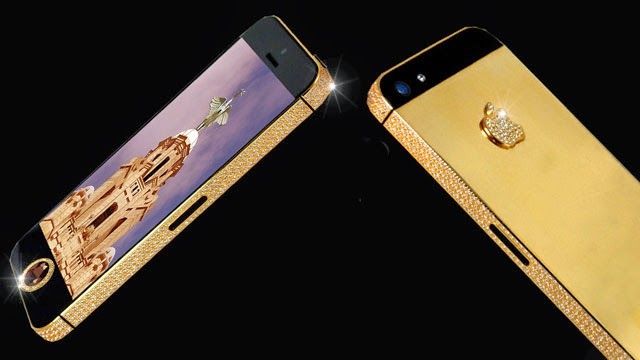
Made using 135gram solid gold of 24 carat, the $15 million iPhone 5 Black Diamond took nine weeks to build. The chassis was inlaid with 600 white diamonds, while the Apple logo on the back boasts of 53 of these gems. Apart from these precious materials, this phone also utilizes sapphire in the screen.

The highlight of this black-and-gold iPhone 5 is the single, flawless black deep-cut diamond that has replaced the home button. Weighing 26-carat, this black diamond belonged to a Chinese business man who commissioned this phone from luxury product maker Stuart Hughes.

iPad 2 Gold History Edition — $7.8 million

Want modern technology embedded with a piece of history? Stuart Hughes has created an iPad 2 that boasts of the shavings of the bone of a 65 million-year-old T-Rex dinosaur. That’s not all. The device’s front frame is made using Ammolite, the oldest rock in the world, dated as many as 75 million years back.

This gadget is also encrusted with 53 flawless diamonds, weighing 12.5-carat. The back panel as well as the Apple logo of this iPad 2 are made using 24-carat gold and weigh 2kg. Priced at a cool $7.8 million, only two units of this iPad 2 Gold History Edition have been made by Stuart Hughes.

Hart Audio D&W Aural Pleasure loudspeakers — $4.7 million

The most expensive pair of speakers in the world was made by Hart Audio in 2012 as part of its Aural Pleasure range. Priced at $4.7 million, there is only one pair available in the world, made of 18-carat gold. Five sets of silver speakers were also made, costing $315,000. The solid phosphor bronze speakers are priced at $63,000, with stocks limited to a total of 99 pairs.

Camael Diamonds iPad — $1.2 million

Diamonds are a girl’s best friends, goes the saying. How about a diamond-encrusted iPad worth $1.2 million? This gadget is crafted with 18-carat gold and has 300-carat diamonds on the back. The Home button in the front and the Apple logo on the back are made using black diamonds. Made by Camael London, this gadget weighs over 1kg.

Macbook Air Supreme Platinum Edition — $500,000

Apple products are among the most expensive in the world and luxury brands are taking it a notch up. Not just iPhones and iPads, but Macbook laptops have also undergone the luxury treatment. The Stuart Hughes Apple MacBook Air Supreme Platinum Edition is made using platinum weighing a massive 7kg, with only five units available across the world. Even without all the diamonds and sapphire, this iteration of Macbook Air costs approximately $500,000.

Nintendo Wii Supreme — $497,300

Nintendo Wii is discontinued now, but Stuart Hughes has made sure that it remains relevant for gamers living a luxurious life. With only three units made, the device costs a hefty $497,300. The Nintendo Wii Supreme is made using solid 22-carat gold, weighs over 2.5kg and takes six months to craft. The front buttons are made using 78x0.25-carat flawless diamonds, weighing a total of 19 carat.

Sony PlayStation 3 Supreme — $331,500

Sony’s PlayStation 3 may be outdated too, but Stuart Hughes has made the device a memorabilia for gamers. The Sony PlayStation 3 Supreme is a $331,500 gaming console that is made using solid 22-carat gold and weighs 1.6kg, with only three pieces ever made. The luxury gaming console has a diamond-studded disc loading slot, adorned with a total of 58 22-carat diamonds.

Steinway Lyngdorf Model LS Concert Speakers — $250,000

Any audiophile worth his/her salt will testify that Steinway Lyngdorf Model LS Concert Speakers are the closest you can come to bringing the concert audio experience into your house. The price of making this happen: $250,000.

Each speaker has glossy piano-black side pieces and 24-carat gold accents around all eight AMT tweeters. The eight-feet-tall and 16-inch-wide speakers use curved drape made of super-thin bungee cords instead of the commonly-used cloth grille.

Diamond BlackBerry Amosu Curva — $240,000

British luxury product maker Alexander Amosu offers a limited edition BlackBerry Curve 8900 phone for $240,000. The phone has a total of 4,459 diamonds weighing 28-carat on the front and back. With body crafted using 18-carat gold, this phone will come with free concierge services for a year. The company will only make three units of this device, which took 350 hours to be crafted.

Gold iPad Supreme — $190,000

If the million-dollar iPads are out of your budget, you can still get a slice of luxury at a lesser price tag of ‘just’ $190,000. With just 10 units in the market, the Gold iPad Supreme is certainly an exclusive item. The back panel and bezel of this product are made using a single piece of 22-carat gold weighing 2.1kg and features diamonds weighing 25-carat. The Apple logo on the back has 53 diamonds weighing 22-carat as well.